Lessons in Architecture: On Identity
Familiarity and Interpretation

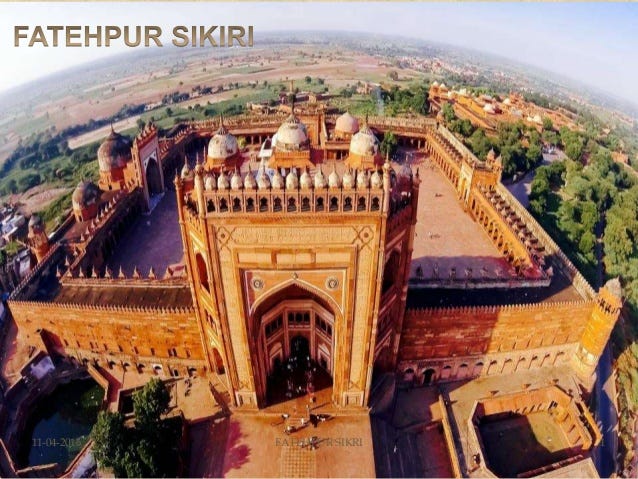
In the town of Fatehpur Sikri stands the Buland Darwaza, Door of Victory, the highest gateway in the world, built in 1575 by Mughal emperor Akbar to commemorate a war victory. The great gate itself is plain, essentially a vaulted archway, a symbol of Persian architecture, within a framework of familiar Hindu elements, appearing in a new, sublime form like the crowning chhatris. The Gate is semi-octagonal in shape and has an excellent visibility from all sides – reflecting the perfect sense of the architecture. Made of red and buff sandstone and decorated by white and black marble, the three horizontal panels of buff stone. The gateway is approached by rising steps from the base. The surface, columns and the top of the arch are inscribed with Quranic verses, carved with floral patterns using white and black marble. The gateway was a later addition to the holy site of Jama Masjid and not part of the original plan. Yet, it never looks out of place or lacking anything. One of the most striking features of the monumental gate is that it was probably less intended to commemorate a military victory than to underscore Akbar’s links with Sufism. The Quranic relief on the surface, in a way evens out the imposing weight of the looming structure. Designed with such power, imagination and intention, the observer feels in sync with the entrance to the complex for devotion and meditation. The rhythmic arabesque pattern produces an effect of order and harmony. This is exactly how it is experienced even today, seamlessly integrated into the environment. This kind of architecture, a blend of Indian and Persian elements in perfect balance, came about only over time as there was increasing experimentation of wanting to create architecture that represented the local culture and the royalty.
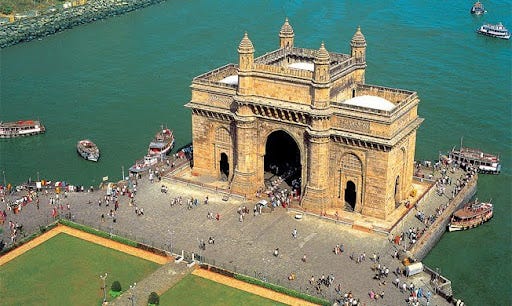
In 1911, George Wittet designed another gate in the city of Bombay (now Mumbai), the Gateway of India to mark the visit of the then British monarch. The gateway is an Indo-Saracenic style memorial arch resembling a triumphial arch and regional architecture of the time. Built in yellow basalt and concrete, it is rectangular in plan, an octopylon with a floor plan of eight piers, seen in other triumphal arches like the Arc de Triomphe, which it is often compared to. Three arched passageways run between the long sides and a single arched passageway between the shorter sides. The facade is reminiscent of Gujarati mosque facades like the the 15th CE Jama Masjid, Ahmedabad, with intricate bands of ornament, and jali (latticework) screens. It was something so new for its time to include elements of colonial architecture, that the architect had to deliberately combine indigenous architectural elements with elements of 16th CE local architecture. The design is restless, displaying an effort to create architecture that was integrated, but also not. While it was unique for its time, standing differently at its location as a port entry into Bombay, over the years it grew into the local culture and became synonymous with Mumbai. It is one of the most crowded places in the city, a spot for Hanukkah celebrations every year and a site for prayers following the 2008 Mumbai terror attacks. This is an example of architecture that was meant to signify conquest, but in turn, wove itself into the fabric of the city.
Usually formal, repetitive rules get tiresome and dull over time, so to maintain curiosity and fascination around a building, an architect necessarily needs to employ multiple combinations of forms and rules or bend them in unconventional ways that take the spectator by surprise. For this reason, in most western countries, a period of meticulously, formal architecture has often been followed by a period of diverging norms and accepted canons. But in other parts of the world such as the Indian subcontinent, Africa and Latin America, history has played out different with different occupiers developing distinct styles over centuries, which has led to the presence of a rich eclectic mix of art and architecture. Architecture has ultimately become a search for an identity/identities that cater to the local context and zeitgeist. For an architect who builds for the sake building, perhaps these thoughts are inconsequential. But an artist must consider rules that permeate the existing urban fabric and their relevance. In architectural terms, the effects of forms and the shadows they create, cavities and darkness, solids and facades, contours and curves.
The most significant architectural contribution that the British made to India was the construction of the capital city, New Delhi. However, post-independence was a period of architectural search for a unique style, belonging and meaning. the 1940s was a period of industrial modernity across the world, and a search for an Indian identity was a first of its kind in a country that was politically independent for the first time. And this arose, not as a break with the preceding eras but rather, a continuation where artists dabbled with formal familiarity along with rethinking the past and portending the future. Architecturally this continues to take shape differently across the landscape where identity differs between different regions. Which means, the larger issue of continuing architecture is one of thinking and creating, rather than breaking the past.
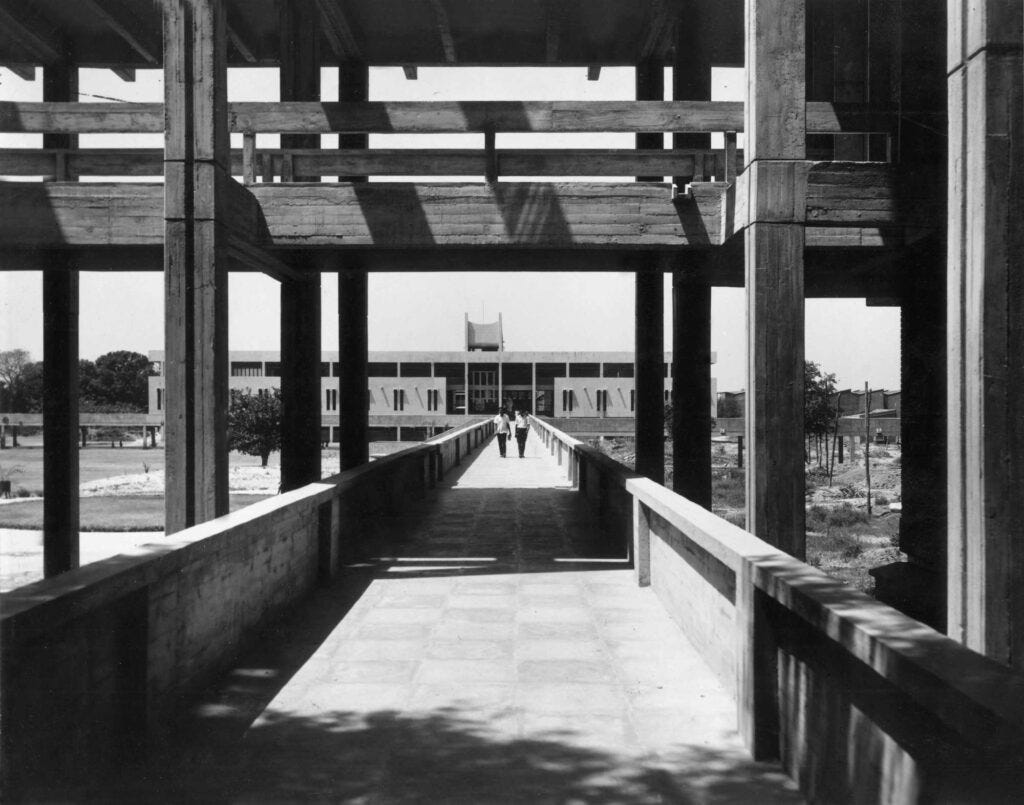
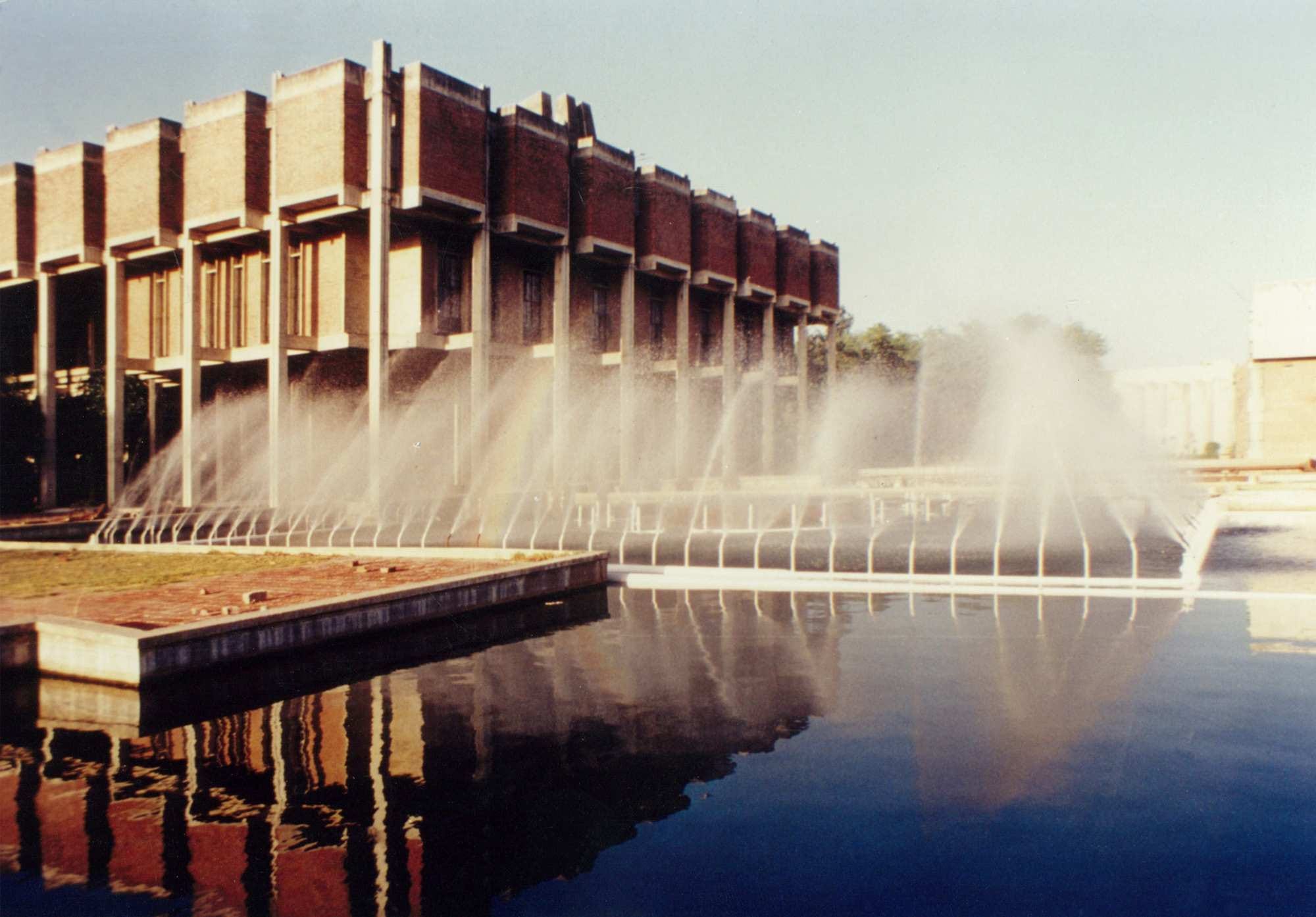
In the 1950s, a building that played a pivotal role in establishing the direction for Indian architecture and the development of its modern heritage was IIT (Indian Institute of Technology) Kanpur designed by Achyut Kanvinde. It introduced a novel idea of multiple disciplines working together to provide an integrated curriculum marked by interconnectedness and flexibility. The building form consists of hierarchical elements that create a system like a human body, based on a 5-minute walking distance - the skeleton being the building framework; muscles, the connecting spaces; the circulatory system, the pedestrian pathways and roads; the administrative block being the brain and the heart, the central plaza with the library. The entire campus follows a 5 metre square grid plan. Decentralising the form allowed for smaller comprehensible clusters centred around a two-level circulation spine, that allowed for future expansion as well. Built in modular solids, blocks, punctures, voids and networks, the building is constructed in local materials of bricks and reinforced concrete cement, along with the newness of using louvres and sun breakers. Landscaping is minimal to emphasise the built form.
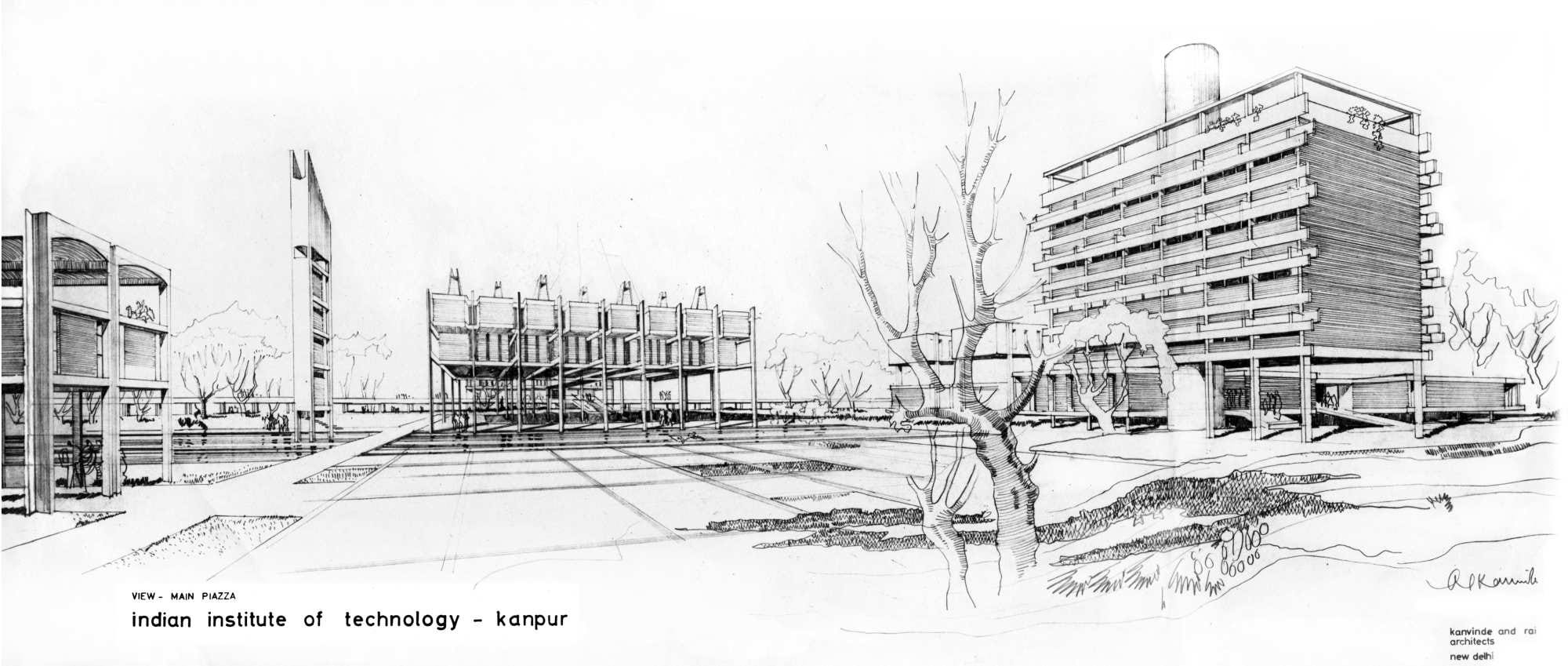
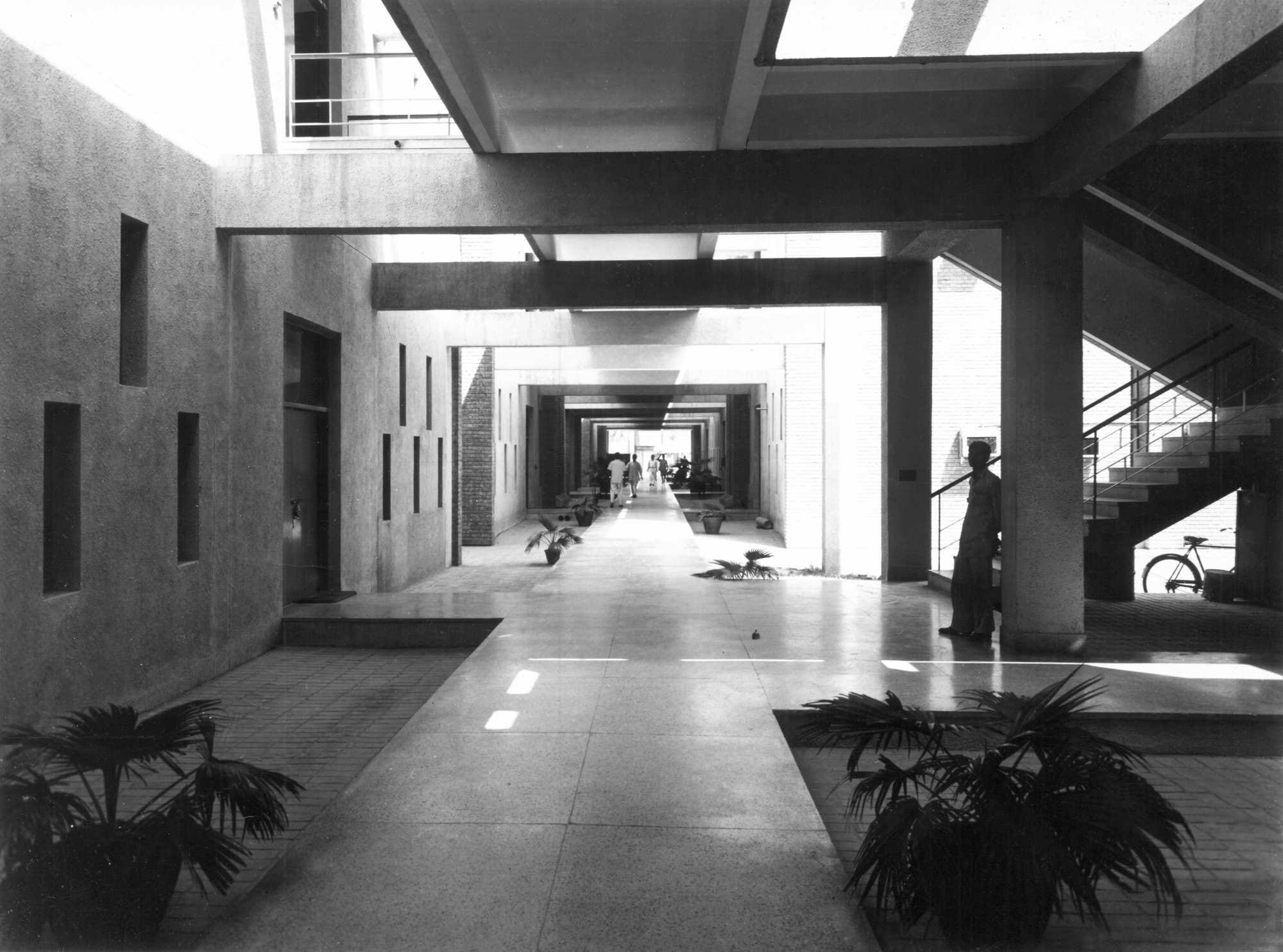
The design diverged from the flamboyance of art-deco style of most of the bigger cities and the cubic volumes and surfaces of the International Style (that Kanvinde was trained in under Walter Gropius, influenced by Le Corbusier and Louis Kahn), by instilling a human quality and scale to the language of Brutalism. Effectively, it was an architectural expression reflecting the culture and aspirations of a newly independent, young India, setting the precedent for several future buildings and institutes. In many ways, it represented the Nehruvian vision of a functionalist, modern identity.
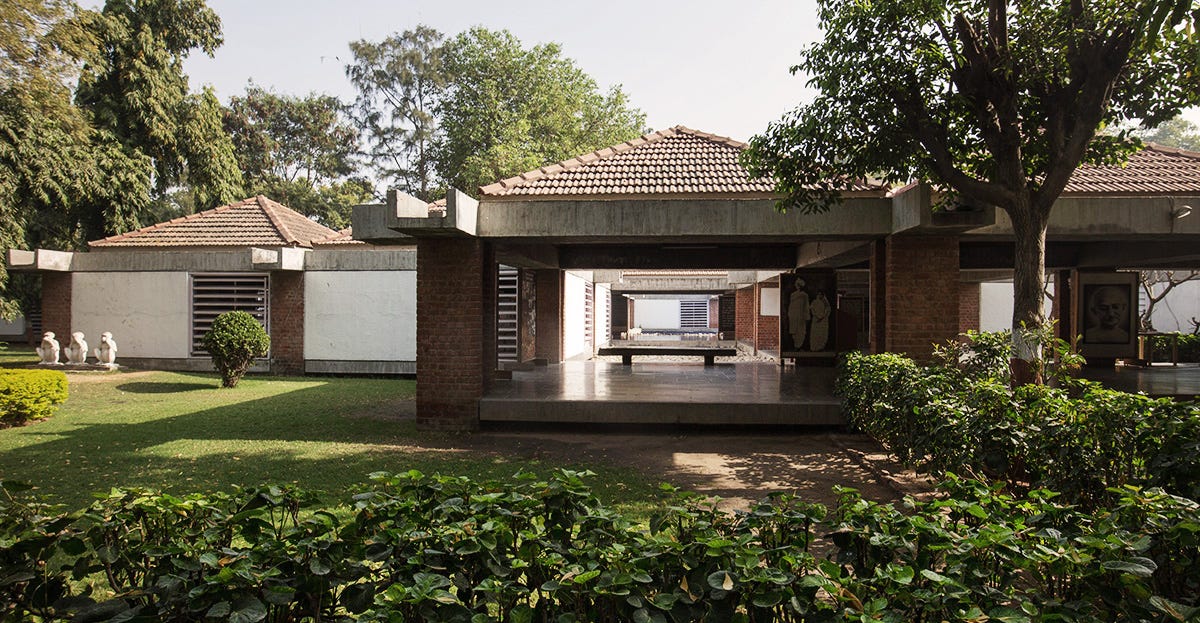
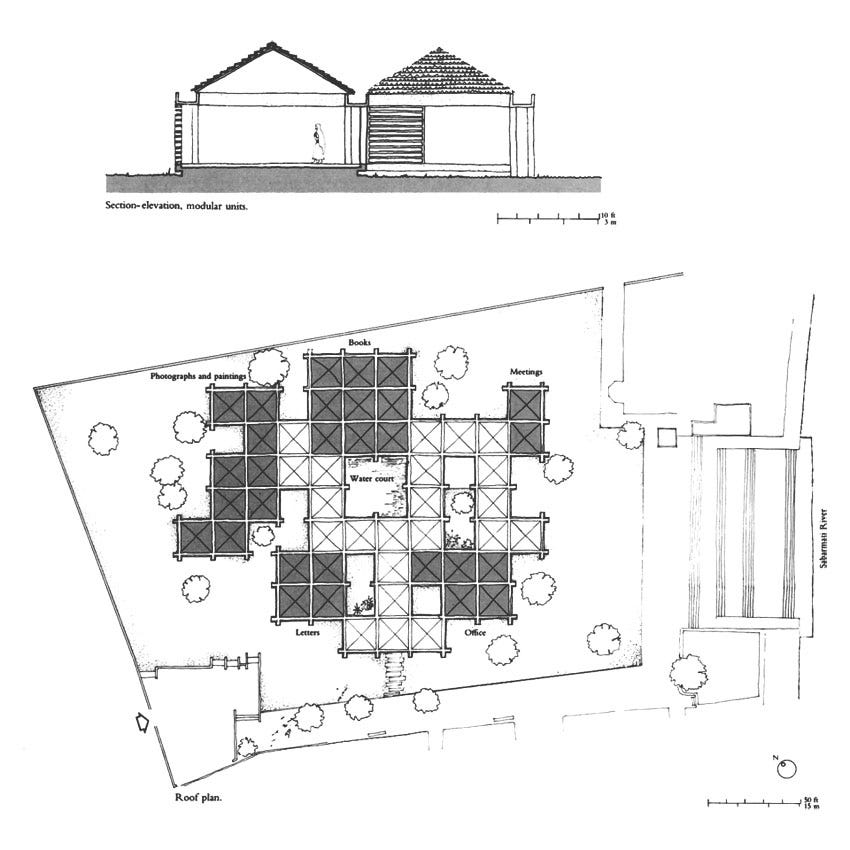
Sabarmati Ashram, Ahmedabad designed by Charles Correa in the 1960s is, but dramatic for its familiarity. It is a physical interpretation of Mahatma Gandhi’s values and philosophies in an already built work, embodying the ideals of simplicity and frugality. A modest and humanly-scaled building, it uses brick piers, stone floors and tiled roofs to realise a contemporary expression for the spirit of swadesi, the encouragement of domestic production and boycott of foreign goods as part of the campaign for independence. Made of reinforced concrete cement, the building consists of modular units measuring 6 metre x 6 metre, connecting spaces that are both open and closed, granting variety in each module’s lighting, temperature and visual permeability. There are winding pathways progressing towards the central water courtyard, around which the rooms are arranged in a simple post and beam structure with load-bearing columns supporting the concrete channels and wooden roof, directing rainwater with boards nailed underneath the joists and tiles placed atop. The planning is similar to a rural Indian village where houses are divided functionally around a courtyard that needs to be traversed each time, making it the most social and public place. Recalling the words of Mahatma Gandhi, “I don’t want my house to be walled on four sides and my windows to be stuffed. I want cultures of all the land to be blown about my houses as freely as possible but I refuse to be blown off my feet by any of them”, the ashram is a spectacular interpretation of an Indian, swadesi identity.
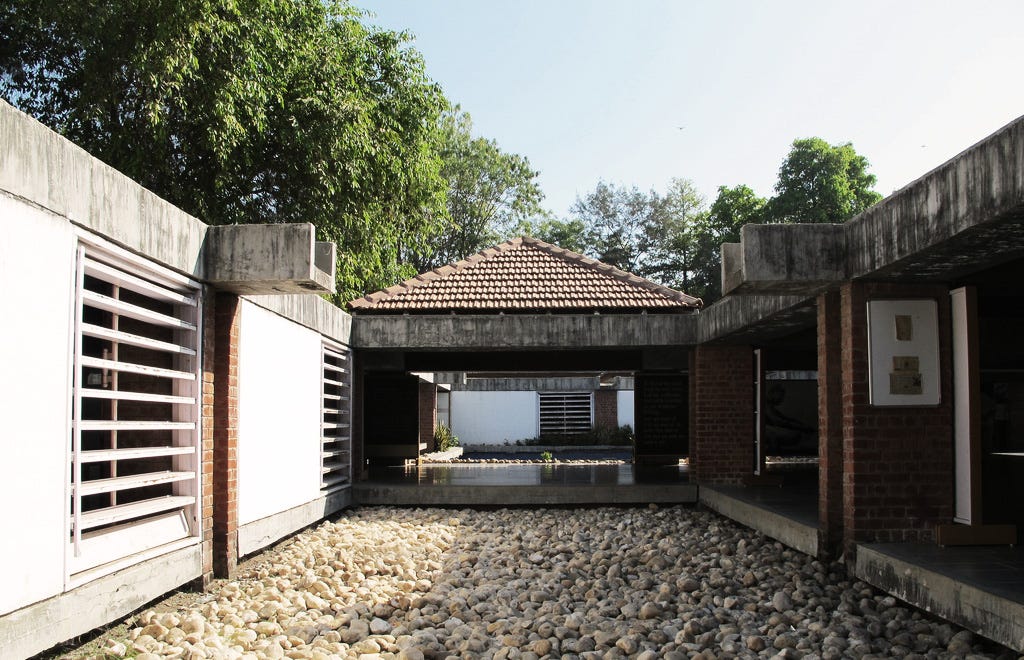
Although their buildings are different in time and style, in seeking Indianness, both architects found certain possibilities in ideologies of people and places, and knew how use them without being limited. The designs still remain striking for their modern perspective on tradition. Integrating gullies (narrow lanes), chowks (squares), edges and such elements of the public space, in broad daylight and in shadows, at different elevations for walking and resting, both design styles come almost straight from the drawing board. This is architecture interpreted as forms which swell, push and pull to recreate building masses through the visual and sensory process. In employing masses and cavities simultaneously, such works turn into the art of theatre and sometimes, even sculpture. Perhaps, in these in-between spaces of dichotomy, does one ultimately seek belonging, meaning and identity. For the spectator in either of the buildings, there is much to think about, yet nothing that particularly states what the building contains.